




Medically Reviewed on September 9, 2026
Guided implant surgery is less invasive because it replaces freehand estimation with a digital plan and a custom surgical guide, allowing the implant to be placed through a small, precise opening instead of a traditional incision that requires cutting and folding back the gum tissue. That reduction in tissue disruption is what typically translates into less bleeding, less swelling, and a more comfortable recovery.
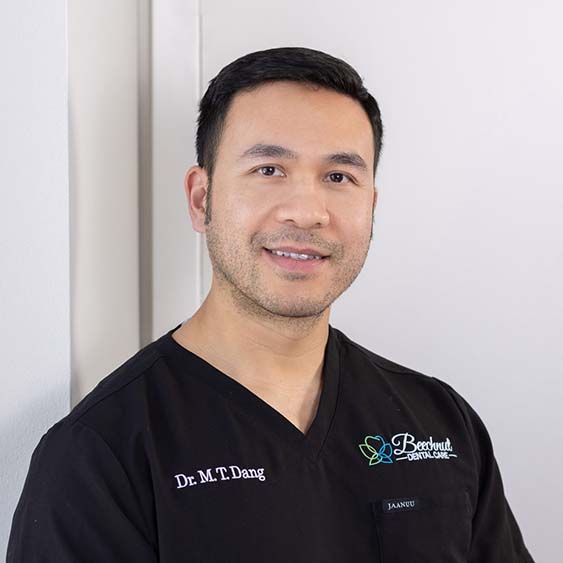
At Beechnut Dental Care, we use guided implant surgery to give Houston patients a more precise, more comfortable path to a restored smile. Dr. Mitch Dang, a University of Texas graduate and recipient of the Hanau Best of the Best Award of Excellence in Prosthodontics, pairs his clinical expertise with the EcoDigi digital implant planning system to ensure every placement is planned in full before we ever step into the operatory. Whether you are exploring All-on-4 dental implants or a single-tooth replacement, guided surgery changes what that process looks and feels like.
How Does Guided Implant Surgery Work
Guided implant surgery begins well before the day of your appointment. Using three-dimensional imaging and digital planning software, we map out the precise position, angle, and depth of every implant before any procedure begins. That plan is then used to create a surgical guide, which is a custom appliance that fits over your teeth and directs the placement of the implant with remarkable accuracy.
This pre-surgical mapping process is what sets guided implant surgery apart from conventional approaches. Rather than relying solely on intraoperative judgment, we work from a detailed, patient-specific plan that accounts for bone density, nerve location, and the final restoration you will receive. The result is a procedure that is not only more predictable, but one that significantly reduces the physical footprint of the surgery itself. A 2023 clinical overview published in PMC on current approaches to guided implant surgery notes that the broader trend in implantology is toward less invasive techniques paired with proper digital treatment planning, which is exactly the philosophy behind our approach.
Why the Flapless Technique Reduces Trauma
One of the most significant advantages of guided implant surgery is that it makes a flapless approach possible in many cases. In traditional implant surgery, the gum tissue must be cut and pulled back to fully expose the bone before placement. With guided surgery, the implant can often be placed through a small, controlled opening in the gum tissue instead.
Less Tissue Disruption Means a Faster Recovery
When the surrounding tissue stays largely intact, your body has far less to heal. Patients who undergo flapless guided surgery typically experience less swelling, less bleeding, and a more comfortable recovery period compared to conventional implant methods. Research published in the National Institutes of Health’s PubMed Central confirms that flapless, computer-guided implant placement enhances blood circulation, reduces periosteum damage, and supports a more minimally invasive surgical outcome.
Precision Reduces the Margin for Error
The surgical guide directs each drill and each implant to the exact position mapped in your digital plan. Because placement does not depend on manual estimation of anatomy, there is less need for corrective movement during surgery. That accuracy translates to less surrounding bone and tissue affected, which is a core reason why guided surgery produces less discomfort and inflammation after the procedure.
What This Means for Your Implant Experience
For patients considering implant restoration, the guided approach changes the treatment experience in real, practical ways. Appointments are typically shorter because the surgical plan has already been finalized. There is less guesswork in the operatory, which means the procedure itself moves more efficiently. Many patients are surprised by how manageable the recovery feels compared to what they imagined going in.
Guided surgery also allows for better long-term outcomes. Because implants are placed in the optimal position for both bone integration and prosthetic fit, the restorations that follow, including crowns, dental bridges, or full-arch solutions, are more stable and more comfortable to wear. The precision built into the surgical step carries forward into every stage of your care. Our digitally planned EcoDigital Guided Implant Procedure is a further extension of this same philosophy, applying the guide-based approach to a wider range of implant cases.
What Recovery Generally Looks Like
Because guided surgery limits the size of the surgical opening, most patients experience a milder first few days than they would with a traditional incision. Mild swelling and soreness for a day or two is normal, and soft foods are recommended during that time. Our detailed dental implant recovery and aftercare guide walks through what to expect at each stage, from the first 24 hours through full osseointegration.
Choose Beechnut Dental Care for Guided Implant Surgery in Houston
At Beechnut Dental Care, guided implant surgery is part of a broader commitment to giving patients the most advanced and comfortable care available. Dr. Dang’s background in prosthodontics and his use of the EcoDigi planning system means every implant case is approached with the detail and intention it deserves. For patients who also need broader reconstruction, our team offers full mouth restorations designed to rebuild your smile from a foundation of precise, well-placed implants.
We believe cost should never stand between you and the care you need. That is why we offer flexible financing options, including Cherry Financing, CareCredit, and in-house membership plans, and we will work with you to find a payment approach that fits your life. If you are ready to learn whether guided implant surgery is the right fit for you, we invite you to reach out to our team and schedule your consultation.
Frequently Asked Questions About Guided Implant Surgery
Does guided implant surgery cost more than traditional surgery?
There is typically an added cost for the 3D imaging and custom surgical guide, but many patients find this offset by fewer complications and a smoother recovery. We provide a full cost breakdown during your consultation so you can weigh the value against your specific case.
How is the surgical guide actually made?
After your 3D scan, planning software maps the exact position of each implant, and that digital plan is used to fabricate a custom appliance that fits precisely over your teeth or gums. The guide contains openings that direct the drill to the planned position, angle, and depth during surgery.
Can guided surgery be used for full-arch or All-on-4 implants?
Yes, guided planning is especially valuable for full-arch cases, since it helps coordinate the placement of multiple implants relative to each other and the final prosthesis. Precise planning up front helps ensure the implants can support a stable, well-fitted restoration.
Is guided implant surgery safer than freehand placement?
Guided surgery reduces reliance on intraoperative estimation, which lowers the risk of placement errors near nerves or sinus cavities. Research on computer-guided placement has associated it with reduced tissue trauma compared to conventional freehand techniques.
How soon can my final crown be placed after guided implant surgery?
Timing depends on how well your bone integrates with the implant, which generally takes three to six months regardless of surgical technique. Guided surgery does not shorten integration time, but the smoother initial recovery often makes the waiting period more comfortable.
